
Cryogen Hazards: Managing Oxygen-Displacement Risks from Cryogenic Fluids and Dry Ice
Asphyxiant gases are a familiar concern in industrial hygiene, especially in enclosed spaces. Cryogenic fluids can intensify that risk because small liquid releases produce large volumes of very cold gas that can quickly displace oxygen. But other sources of asphyxiant gases such as dry ice or gas cylinders can create similar hazards when gases accumulate in enclosed or poorly ventilated spaces.
| Key points • Cryogenic fluids and dry ice can rapidly create oxygen-deficient atmospheres in enclosed or poorly ventilated spaces.• The primary hazards are oxygen displacement, pressure buildup, cold-contact injuries, and equipment failure. • Monitoring and ventilation must be designed around gas density, likely release points, and the worker breathing zone. • Training, preventive maintenance, and process hazard analysis are essential for preventing catastrophic events. |
BACKGROUND
Cryogens are substances that exist as liquids at extremely low temperatures and as gases at standard temperature and pressure. Definitions vary. The International Institute of Refrigeration describes cryogens as fluids with boiling points below 120 Kelvin (minus 244 degrees Fahrenheit), while NFPA defines cryogenic fluids as having boiling points below 183 Kelvin (minus 130 degrees Fahrenheit).
Cryogenic fluids are widely used in aerospace, healthcare, food and beverage, biopharma, and technology. Hydrogen, methane, and oxygen are critical to spacecraft propulsion and life-support systems. Argon and nitrogen help control fire hazards and limit oxidation in welding and other industrial processes. Liquid nitrogen is especially common, used in food preservation, beverage production, and cryo-refrigeration for long-term storage of tissue cultures, vaccines, and other biological samples.
Cryogenic fluids are typically stored in vacuum-insulated flasks, commonly called dewars, or in large above-ground tanks with vacuum-insulated jackets. These systems depend on more than insulation alone. Safe operation also requires suitable structural supports, pressure-relief devices, emergency shutoff valves, compatible materials of construction, and reliable oxygen monitoring.
Although dry ice is not a cryogenic liquid, it belongs in the same risk conversation when evaluating oxygen-displacement hazards. Dry ice is solid carbon dioxide and sublimates directly to gas. In vehicles, coolers, storage rooms, walk-in refrigerators, and other enclosed spaces, that gas can accumulate quickly and create hazardous atmospheres if ventilation is inadequate.
HAZARDS
Cryogenic systems present multiple hazards that OEHS professionals must evaluate. The most serious is oxygen displacement. As cryogenic liquids warm and boil off, they expand dramatically into gas. In a release, transfer, spill, or routine venting event, that gas can sink and spread, reducing the available oxygen in the space before workers recognize the danger.
Pressure is another major concern. Boil-off can over-pressurize closed or obstructed containers, causing rupture and launching fragments or heavy equipment components. This type of event can occur when pressure-relief devices fail, are blocked, or are improperly modified. A related hazard exists when cryogenic liquid leaks into sample vials or other sealed containers and later expands as the material warms.
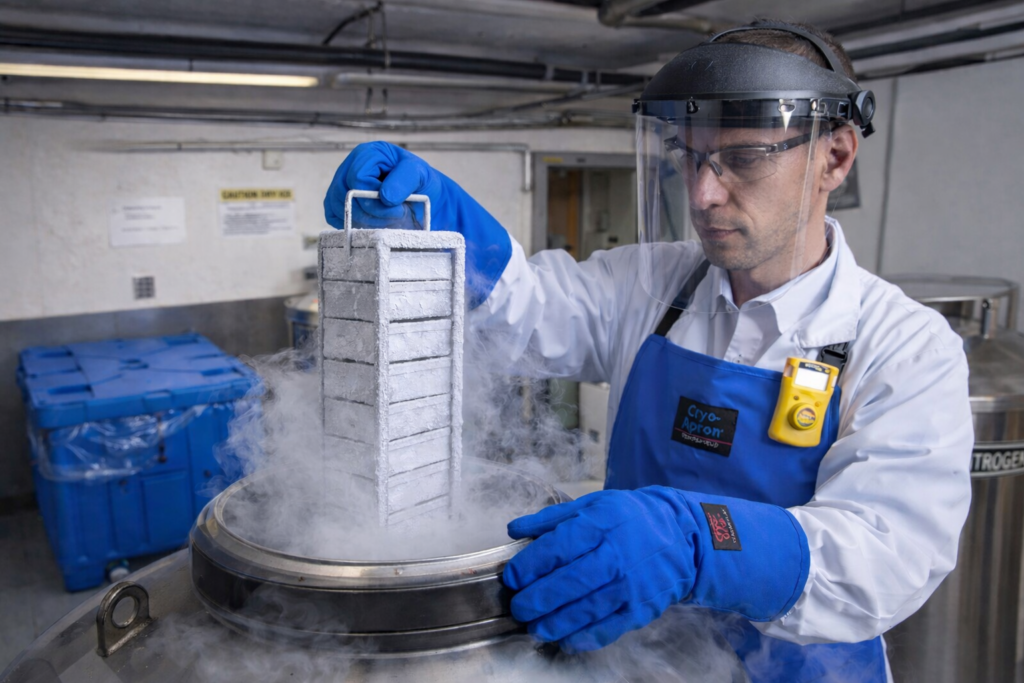
Cryogenic liquids also create severe cold-contact hazards. Exposed skin can freeze almost instantly, producing frostbite-like injuries and tissue damage. During dispensing and transfer tasks, appropriate PPE may include a face shield, insulated gloves, and an apron designed for cryogenic service. Where splash or spill potential extends to the lower legs and feet, insulated gaiters and other lower-body protection may be warranted.
Dry ice can create similar atmospheric hazards. When it sublimates, carbon dioxide may collect in low or enclosed areas, including vehicle interiors and small storage spaces. The underlying issue is the same: any source that can release a large volume of asphyxiant gas deserves the same attention to safety controls, including ventilation, monitoring, and worker training.
MONITORING
Under normal conditions, some gas will boil off from cryogenic fluids and escape through pressure-relief devices or during routine activities such as filling containers and retrieving samples. The gas cloud may initially appear visible because it freezes water vapor in the surrounding air, but the visible cloud is only a partial indicator of the affected area. The more important issue is that the cold gas may remain low to the ground and displace oxygen in the worker breathing zone, especially where workers may sit or crouch low.
Oxygen monitoring must be designed around how the gas will actually move through the space. Sensors placed too close to the source, or too close to the floor, may alarm constantly because they are detecting highly localized, short-lived conditions that do not represent worker exposure. Frequent nuisance alarms can desensitize employees and be ignored. A better practice is to place sensors at the lowest likely breathing-zone height in the room, such as seated height when workers perform tasks while sitting, as determined through a risk assessment.
Monitoring systems must also be maintained. Oxygen sensors have a finite service life and should be calibrated at the manufacturer-recommended frequency, often every one to three months, and replaced on a preventive schedule before failure. The strongest systems do more than activate local horns and strobes; they also notify security, facilities, or other response personnel through the building management system.
Training is just as important as instrumentation. Workers need to understand that a low-oxygen alarm signals an emergency condition, not a maintenance inconvenience. They should immediately leave the area or remain outside it. Reentry during an alarm condition is appropriate only for trained emergency responders equipped for unknown or IDLH atmospheres. For those environments, OSHA requires supplied air: either a full-face, pressure-demand self-contained breathing apparatus (SCBA) or a combination full-face, pressure-demand supplied-air respirator with an auxiliary escape supply.
Alarm thresholds should account for the difference between early warning and life-threatening conditions. OSHA defines oxygen deficiency as less than 19.5% oxygen content. ANSI/ASSE Z88.2-2015 notes that, at altitudes below 3,001 feet above sea level, the margin of safety is roughly 16 to 19.5 percent oxygen. Below that range, acute effects become more likely: impaired coordination, abnormal fatigue, poor judgment, collapse, and unconsciousness. Work at high elevation adds another layer of complexity because the partial pressure of oxygen is already lower at higher altitudes. ACGIH recommends minimum ambient oxygen levels in terms of partial pressure. The ACGIH threshold limit value (TLV) is 132 torr, the expected oxygen partial pressure at 5,000 feet elevation. Facilities operating at higher elevations should account for the reduced safety margin when establishing monitoring and alert strategies and training, especially for unacclimatized workers. Acclimating workers to the altitude of the work can increase an individual’s work capacity by 70%, as physiological adaptations increase oxygen delivery. These adaptations begin within 24-hours but can take 7 days to reach full acclimatization.
VENTILATION
Ventilation is often the most effective engineering control for managing atmospheric hazards, but only if the system is designed for the gas being released. Gases that boil off from cryogenic liquids are extremely cold and initially denser than the surrounding room air, so they tend to sink. NFPA 55-2023 requires indoor areas where cryogenic fluids are stored or dispensed to be ventilated in accordance with Section 6.17 and the applicable mechanical code. That section calls for mechanical exhaust ventilation or fixed natural ventilation of at least 1 cubic foot per minute per square foot of floor area in indoor spaces where cryogenic fluids are stored or used.
Ventilation design must also account for gas density. Where gases heavier than air may be released, mechanical exhaust openings should be located within 12 inches of the floor. Exhaust air should never be recirculated because standard HVAC systems typically filter only particulates, returning gases to occupied areas.
These requirements are often overlooked when spaces are repurposed. A room intended for ordinary occupancy may later become a cryogen storage or use area without a corresponding hazard analysis or management-of-change review. Standard office HVAC systems with ceiling supply and returns and air recirculation provide inadequate ventilation for asphyxiant gases and do little to prevent oxygen deficiency.
Release modeling can help the design team understand both routine off-gassing and worst-case events such as spills, leaks, and catastrophic equipment failures. In some facilities, large releases may affect adjacent areas. In those cases, oxygen-monitoring alarms may need to extend beyond the immediate storage/use area. The same principle applies to dry ice storage rooms, coolers, and transport vehicles. Ventilation has to be assessed for the actual enclosure and load, not assumed to be adequate.
INCIDENTS AND LESSONS LEARNED
Real-world incidents show why disciplined hazard analysis is essential for cryogenic systems and related asphyxiant gas sources.
A liquid nitrogen dewar exploded at Texas A&M University in 2006 after a malfunctioning pressure-relief device was sealed by someone who did not understand the hazard. About 12 hours after sealing the dewer, the bottom ruptured, propelling the tank through the ceiling and shifting the laboratory walls off their foundations.
At a Georgia poultry processing facility in 2021, a liquid nitrogen release killed six workers and injured 11 others. The U.S. Chemical Safety and Hazard Investigation Board later concluded that failures in preventive maintenance and process safety management contributed to the event, including the failure of the immersion freezer’s liquid-level control system to accurately measure and control nitrogen levels.
A more recent Illinois case highlights that oxygen-displacement hazards are not limited to cryogenic liquids. The 2016 death of courier Eric Johnson resulted in a wrongful-death verdict, with the jury returning a $241 million verdict after he suffocated in a transport vehicle. The case centered on allegations that he was not warned about ventilation requirements or the risk of carbon dioxide buildup from sublimating dry ice.
The common thread across these events is not simply equipment failure. It is the breakdown of basic risk-management practices: hazard communication, training, preventive maintenance, management of change, emergency planning, and engineering controls matched to the actual hazard.
RISK MANAGEMENT
Cryogenic fluids and asphyxiant gases illustrate why OEHS professionals must combine process understanding with practical controls. Effective risk assessments, hazard and operability studies, job safety analyses, and management-of-change procedures are critical for identifying how cryogenic systems can fail and what layers of protection are necessary.
That process-safety mindset is especially important in large distribution systems that feed process equipment, dispensing stations, phase separators, evaporators, and pressure-relief devices throughout a facility. Breaking the system into simpler functional sections makes it easier to evaluate credible failure modes, exposure pathways, emergency response requirements, and maintenance needs.
Available guidance from NFPA, CGA, CSB, ANSI, OSHA, and other industry groups gives organizations a strong starting point. The greater risk is assuming that cryogens are routine utilities and skipping the analyses needed to support safe design and operation. When oxygen-deficiency hazards are underestimated, workers often have little to no warning and may not be able self-rescue or wait for rescue become succumbing to hypoxia.
RESOURCES
- American Conference of Governmental Industrial Hygienists: 2026 TLVs and BEIs Based on the Documentation of the Threshold Limit Values for Chemical Substances and Physical Agents and Biological Exposure Indices.
- American National Standards Institute: ANSI/ASSE Z88.2, Practices for Respiratory Protection (2015).
- U.S. Chemical Safety and Hazard Investigation Board (CSB): “CSB Releases Final Report into 2021 Fatal Liquid Nitrogen Release at Foundation Food Group Facility in Georgia” (December 2023).
- Compressed Gas Association: CGA P-12 Guideline for Safe Handling of Cryogenic and Refrigerated Liquids (January 2023).
- Compressed Gas Association: CGA P-76 Hazards of Oxygen-Deficient Atmospheres (October 2018)
- Expert Institute: “$241M Illinois Verdict in Dry Ice Wrongful Death” (2026).
- National Fire Protection Association: NFPA 55, Compressed Gases and Cryogenic Fluids Code (2023).
- OSHA: Occupational Safety and Health Administration Standards, Personal Protective Equipment, Respiratory Protection.
- Texas Department of Insurance: State Fire Marshal’s Alert, “University Campus Liquid Nitrogen Cylinder Explosion” (February 2006).