
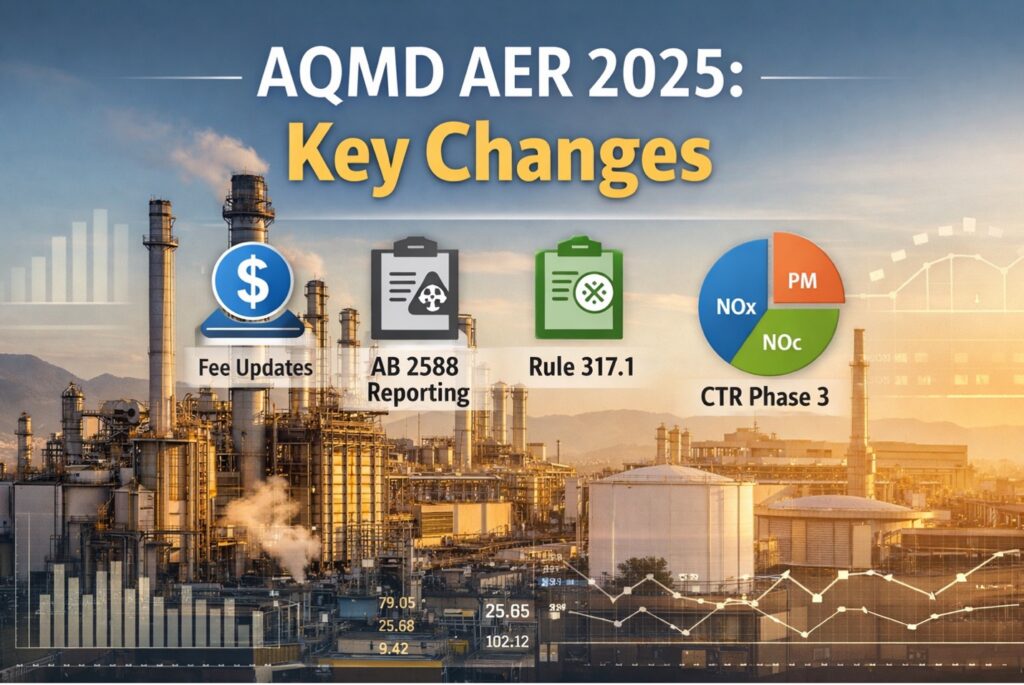
What’s New for AQMD Annual Emissions Reporting (Data Year 2025): Key Changes & What Facilities Need to Know
The South Coast Air Quality Management District (AQMD) has released updates for the Data Year (DY) 2025 Annual Emissions Reporting (AER) cycle, and while the framework remains familiar, several important changes could impact your compliance strategy.
If your facility is subject to AER requirements, now is the time to understand what’s new – and how to prepare ahead of the May 1, 2026 deadline (5:00 PM).
A Quick Refresher: What is AER?
The AER program requires certain permitted facilities to report annual air emissions and pay associated fees, supporting air quality planning, regulatory compliance, and public health initiatives.
Facilities typically subject to reporting include those exceeding emission thresholds, subject to CARB CTR regulations, AB 2588, or AQMD Rule 317.1.
What’s New for Data Year 2025
- AB 2588 Quadrennial Reporting Requirement
For this reporting cycle, Phase 2 AB 2588 facilities must submit a quadrennial report alongside their AER submission.
This adds a layer of complexity – especially for facilities that haven’t prepared toxics inventories recently.
- Fee Updates Fully Implemented
Several fee-related changes are now fully in effect:
- CPI-based fee increases (~3%) across pollutant categories
- Abbreviated reporting fee finalized at $109.67 per report
Facilities should expect slightly higher compliance costs and ensure budgets reflect these updates.
- Expanded Abbreviated Reporting Eligibility
There is expanded flexibility for certain operations:
- Emergency engines now qualify under abbreviated reporting
- Includes renewable diesel and biodiesel fuels
This is a meaningful simplification for facilities with limited or specific emission sources.
- Rule 317.1 Reporting Requirement
Facilities subject to Rule 317.1 (Non-attainment Fees for 8-hour ozone standards) are now explicitly required to report emissions for DY 2025.
If you’re unsure of applicability, this is a critical area to verify early.
- CTR Phase 3 Applicability Continues
While there are no changes for “core” CTR facilities, reporting continues to expand:
- CTR Phase 3 facilities must report for DY 2025
- All CTR facilities should prepare for expanded reporting in 2026
This reflects California’s broader push toward comprehensive emissions inventories.
Key Dates to Remember
- Reporting Year: January 1 – December 31, 2025
- Submission Deadline: May 1, 2026 (5:00 PM)
Missing the deadline can result in late fees and enforcement actions, so early preparation is essential.
What This Means for Your Facility
The DY 2025 updates reinforce a clear trend:
More comprehensive reporting, broader applicability, and increased regulatory alignment across programs.
To stay ahead:
- Start compiling emissions data early
- Confirm applicability under CTR and Rule 317.1
- Budget for updated fees
- Prepare AB 2588 documentation (if applicable)
- Review eligibility for abbreviated reporting
Final Thoughts
While the changes for 2025 are incremental, their combined impact can significantly affect compliance workload and risk exposure.
Facilities that plan ahead – and understand the nuances – will be best positioned to avoid penalties and streamline reporting.
If you’re unsure where your facility stands, this is the right time to get clarity.