
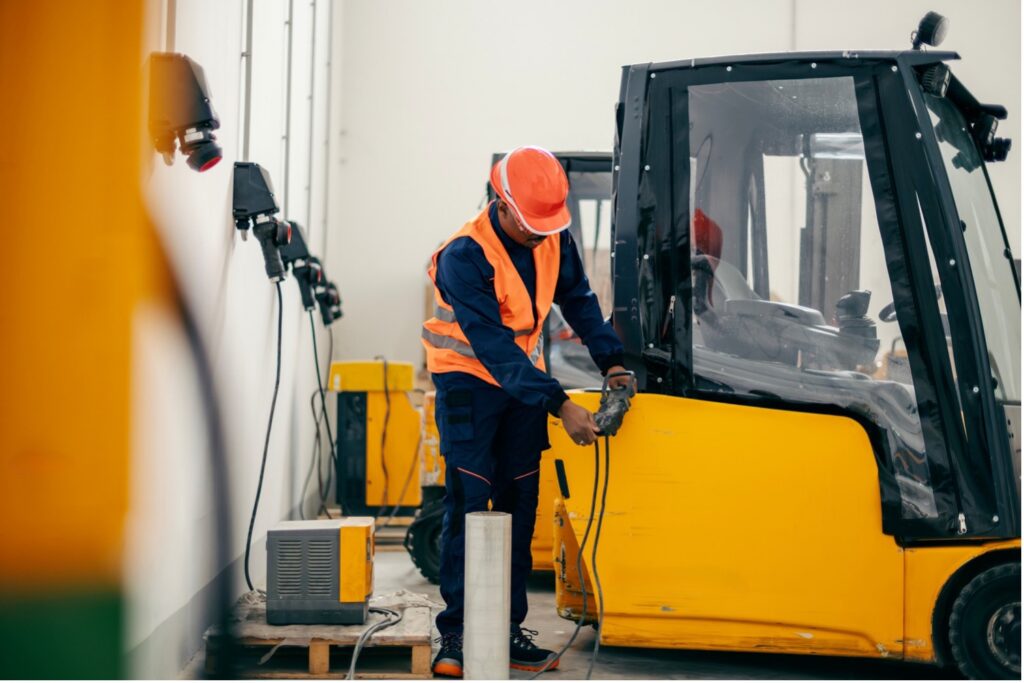
California is accelerating its transition to cleaner operations with the CARB Zero-Emission Forklift (ZEF) Regulation, a rule that directly impacts fleets operating large spark-ignition (LSI) forklifts—commonly powered by propane, gasoline, or natural gas.
For small fleets (fewer than 25 forklifts), understanding the timeline and preparing early will be critical to maintaining compliance and avoiding operational disruptions.
What the Regulation Requires
The ZEF regulation mandates a gradual shift away from LSI forklifts to zero-emission alternatives, primarily electric forklifts. This transition is not immediate but follows a structured phase-out schedule based on:
- Forklift type (Class IV for cushion-tired & V for pneumatic-tired)
- Model year (MY)
- Fleet size
Additionally, low-use forklifts (operating less than 200 hours per year) must be retired or replaced by December 31, 2030, regardless of other timelines.
Key Requirement Starting in 2026
Beginning in 2026, state and local government fleets must:
- Begin formal transition planning
- Engage with their electric utility provider
- Assess charging infrastructure needs
While the regulation is currently not being enforced for privately owned or federal fleets, this milestone signals when infrastructure planning becomes essential across industries.
Phase-Out Timeline for Small Fleets
For fleets with fewer than 25 forklifts, CARB provides structured compliance dates. Based on the schedules:
- Older forklifts (2016 MY and earlier) begin phasing out as early as 2029
- Mid-range model years (2017–2023) follow in staged deadlines through 2036
- Newer forklifts (2024–2025 MY) must be retired by 2038
- For higher-capacity forklifts (>12,000 lbs), phase-out extends to 2025 MY and older by 2038
For Class V LSI forklifts specifically:
- Units from 2017 MY and older must be retired starting 2030
- Newer models phase out through 2038
These timelines allow flexibility – but only if fleets begin planning now.
What This Means for Small Fleets
While small fleets have more time compared to larger operations, the transition still requires:
- Capital planning for equipment replacement
- Electrical infrastructure upgrades
- Operational adjustments for charging and downtime
- Vendor coordination for equipment procurement
Delaying action can lead to bottlenecks, especially as demand for electric forklifts and infrastructure increases.
Recommended Next Steps
To stay ahead of compliance requirements:
- Inventory your fleet (age, type, usage hours)
- Identify low-use forklifts subject to the 2030 deadline
- Develop a phased replacement strategy
- Contact your utility provider early to assess power capacity (was due March 31, 2026)
- Budget for infrastructure and equipment investments
Learn More
For a full breakdown of requirements, timelines, and applicability, review the official regulation overview:
https://ww2.arb.ca.gov/our-work/programs/zero-emission-forklifts
Bottom line: The ZEF regulation is not just a compliance requirement – it’s a long -term operational shift. Small fleets that start planning early will be in the best position to transition smoothly and cost-effectively.
For more information, contact Nalinna Rasu at nrasu@citadelehs.com or (818) 246-2707