
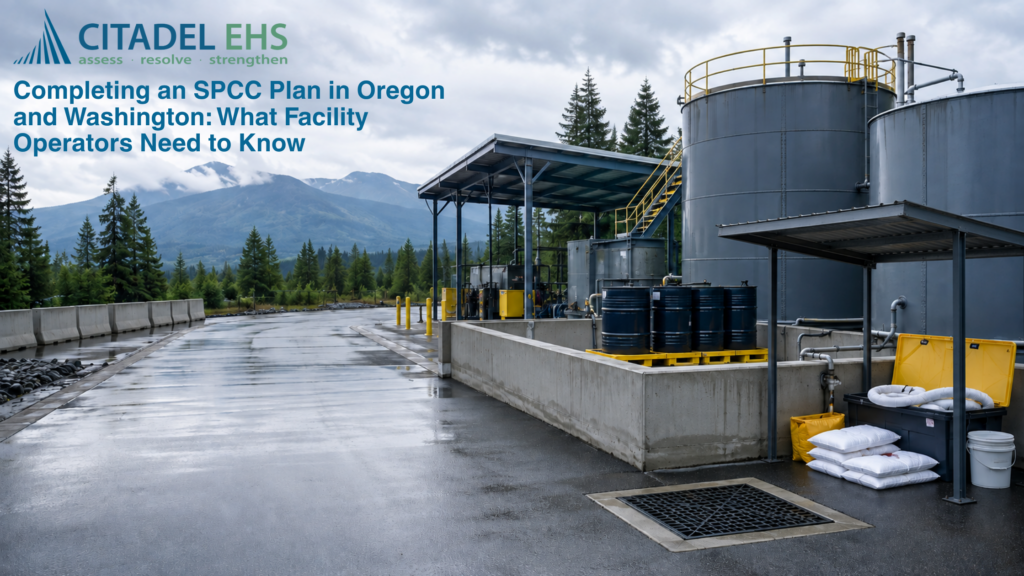
A practical guide to Spill Prevention, Control, and Countermeasure compliance for Pacific Northwest facilities
| Quick answer: If your facility stores oil above federal thresholds and a spill could reasonably reach navigable waters or adjoining shorelines, an SPCC Plan may be required under 40 CFR Part 112. Oregon and Washington facilities may also have state spill-reporting and industrial stormwater permit obligations that should be coordinated with the SPCC Plan. |
Why an SPCC Plan matters
A Spill Prevention, Control, and Countermeasure (SPCC) Plan is a facility-specific roadmap for preventing oil releases, containing spills before they leave the site, and responding quickly when an incident occurs. For industrial operations in Oregon and Washington, a well-prepared plan can also simplify inspections, training, stormwater compliance, and day-to-day environmental management.
The federal SPCC rule is administered by the U.S. Environmental Protection Agency (EPA) under 40 CFR Part 112. In general, the rule applies to non-transportation-related facilities that store, use, process, or transfer oil; have more than 1,320 gallons of aggregate aboveground oil storage capacity or more than 42,000 gallons of qualifying completely buried oil storage capacity; and could reasonably discharge oil to navigable waters or adjoining shorelines. Containers smaller than 55 gallons generally are not counted toward the aboveground threshold.
What should an SPCC Plan include?
An effective SPCC Plan should be easy for facility personnel to use. Typical elements include:
- A facility description and oil storage inventory, including tanks, totes, drums, generators, hydraulic systems, transformers, and other applicable oil-filled equipment.
- A site diagram showing oil storage locations, transfer areas, drainage pathways, storm drains, secondary containment, and nearby surface waters.
- Spill prevention controls such as secondary containment, overfill protection, inspections, housekeeping, and safe transfer procedures.
- Spill response procedures, notification responsibilities, cleanup materials, and employee training requirements.
- Inspection and recordkeeping procedures, along with management approval and required certifications.
Most SPCC Plans must be certified by a licensed Professional Engineer unless the facility qualifies for EPA self-certification. Plans must be reviewed at least once every five years and amended when facility changes materially affect discharge potential.
Oregon SPCC and stormwater considerations
Federal SPCC requirements apply in Oregon, but they do not replace Oregon Department of Environmental Quality (DEQ) requirements. Facilities should evaluate SPCC together with applicable spill reporting and water quality obligations.
Oregon DEQ administers the NPDES 1200-Z Industrial Stormwater General Permit, effective July 1, 2026. Covered facilities maintain a Stormwater Pollution Control Plan (SWPCP), implement best management practices, monitor as required, and address spills and leaks. Coordinating the SPCC Plan with the SWPCP can keep site maps, inspections, containment, and response procedures consistent.
Oregon also has separate spill-reporting requirements: DEQ states that any amount of oil discharged to state waters is reportable, and oil spills to land greater than 42 gallons are reportable. These notifications should be built into facility response procedures.
Washington SPCC and stormwater considerations
Federal SPCC requirements also apply in Washington. The Washington State Department of Ecology administers the Industrial Stormwater General Permit (ISGP), an NPDES and State Waste Discharge permit effective January 1, 2025 through December 31, 2029. Covered facilities generally maintain a SWPPP, implement best management practices, inspect and monitor, and maintain spill-prevention and emergency-cleanup procedures.
Washington also has state spill prevention and reporting programs. Oil or hazardous substance spills to water must be reported immediately, and certain large oil-handling facilities have additional prevention-plan requirements. Aligning SPCC, the SWPPP, and emergency procedures helps create one clear operating approach.
How NPDES permits connect to SPCC compliance
SPCC and NPDES are separate regulatory programs, but they often overlap at industrial sites. SPCC focuses on preventing oil discharges to waters and adjoining shorelines; industrial stormwater permits focus on keeping pollutants, including oil and grease, out of stormwater discharges. A facility may therefore have both obligations.
Coordinating the programs can reduce duplicate work. Secondary containment, spill kits, fueling controls, inspections, training, drainage maps, and spill-response procedures can often support both programs, provided each plan independently satisfies its applicable requirements.
When should you update your SPCC Plan?
Consider reviewing your plan whenever you:
- Install, remove, replace, or relocate an oil storage container.
- Change products, processes, transfer areas, piping, or drainage patterns.
- Modify secondary containment or site construction.
- Experience a spill, near miss, or inspection finding that reveals a gap.
- Reach the required five-year SPCC review date.
Early review is especially useful during expansions, acquisitions, tenant changes, and capital projects, when compliance requirements may affect layout, containment, or operations.
How Citadel EHS can help
Citadel EHS helps clients evaluate SPCC applicability, prepare and update SPCC Plans, complete facility inspections, develop practical spill-prevention measures, support Professional Engineer certification where required, and coordinate SPCC compliance with industrial stormwater and NPDES permitting. We also provide stormwater plan development, training, regulatory review, recordkeeping, and related tank and hazardous materials compliance support.
Need help with an SPCC Plan in Oregon, Washington, or elsewhere in the Pacific Northwest? Contact Craig Peterson, Principal Environmental Engineer, at cpeterson@CitadelEHS.com or (503) 333-0856.For California or the rest of the United States, contact Nalinna Rasu, Practice Leader, Environmental Compliance at nrasu@CitadelEHS.com or (818) 246-2707.